
発表内容
Examination of snow damage
occurring in artificial forests in Japan.
Noguchi, T., Kobayashi, M.,
Tanaka, K.
Plantations of
Japanese cedar and Japanese cypress were promoted aggressively after World War
II in Japan. However, many
plantations have since been abandoned due to a long-term decline in timber prices, caused by high-volume imports of foreign lumber. Trees in
abandoned plantations are spindly with non-uniform
width of annual rings, causing weakness in tree trunks. This weakness increases the risk of weather-related damage such as wind and snow damage.
Moreover, this weather-related damage has been
increasing in line with global climate change in recent years. In fact, serious snow damage occurred in the central part of Kyoto Prefecture
in January 2009. The results of topographical
analysis by GIS showed that both the snow damage during calm conditions in 2009 and the wind damage caused by Typhoon 23 in 2004 occurred mainly on
north-facing slopes. Annual ring analysis
showed that the outer rings of snow-damaged trees were extraordinarily narrow. These results suggest that some trees surviving the
wind damage caused by Typhoon 23 had cracked along
their annual rings (ring shake), and trees weakened in this way then suffered snow damage due to the accretion of heavy snow on their crowns.
(和訳)
日本の人工林で発生した冠雪害の発生要因の特定
日本では第二次世界大戦後スギとヒノキの植林が活発に実施された。しかし、外国産材の大量輸入に伴った、長期にわたる国産材価格の低下により、多くの人工林が放置されている。放置人工林の立木は細長く年輪幅が不均一であるため、幹の強度が低下している。この強度低下は風害や冠雪害といった森林気象害が発生するリスクを増大させる。さらに、近年の地球規模の気候変動に伴い、森林気象害の発生が増加している。実際に、2009年1月に京都府の中部において甚大な冠雪害が発生した。GISを用いた地形解析の結果、2009年に発生した冠雪害と、2004年に発生した台風23号による風害は、いずれも北向きの斜面で多発していた。また、年輪解析の結果、幹の外周部の年輪幅が極端に狭くなっているという結果が示された。以上の結果にから、台風23号による風害を免れたかのように見える残存木には年輪に沿った割れ(目廻り)が生じて、幹の強度が低下しており、そのため樹冠部に着雪した重たい雪によって冠雪害を被ったということが示唆された。
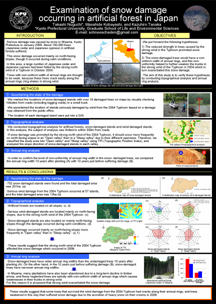

ポスター(クリックして拡大)
メインへ